
In an otherwise agriculture- and public health-focused Union Budget 2018-19, artificial intelligence, machine learning, blockchain technology, internet of things -- jargons that found little or no mention in the previous Budgets -- managed to make their presence felt.
The sole intention of the opposition parties is to create roadblocks on the path of development, the prime minister said, as he termed their action "anti national".


A large number of states, including Congress-ruled Kerala, are opposing the decision on concerns that the entry of foreign retailers like Walmart would lead to displacement of the neighbourhood kirana stores.

A homemaker in every family would get a monthly assistance of Rs 1,000, the manifesto said.

'We will be looking to prune our portfolio to make GIC Re a healthier entity.'

The severity of the second wave of COVID-19 infections in India poses a key challenge for the FMCG industry and the spread of the virus to rural areas on a relatively higher scale as compared to the first wave is also expected to weigh on industry growth outlook, according to ITC Ltd. There is heightened uncertainty around the timing and shape of the recovery trajectory of overall economic growth in India due to the virus, the company said in its Annual Report for 2020-21. In terms of consumption, urban-led recovery may be relatively muted compared to the first wave as consumers switch to precautionary savings mode and rising healthcare costs eat into household spending, while rural demand may also be blunted by the large-scale spread of the virus to the hinterland in the second wave.

The Budget kept away from mood dampeners such as an increase in taxes (capital gain taxes) and even the much-feared introduction of Covid cess and wealth taxes, says Nimesh Kampani, chairman, JM Financial.
According to official sources, the scheme will support a new objective of asset creation along with its current job of funding project and schemes.
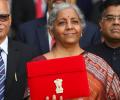
Had Finance Minister Sitharaman thought a little more about the middle class, disadvantaged sections, and the poor who are struggling, it would have been an inclusive Budget that would have made history, notes Ramesh Menon.
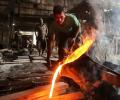
Prime Minister Narendra Modi on Friday said production linked incentive (PLI) scheme, which is aimed at boosting domestic manufacturing and exports, is expected to increase the country's production by $520 billion in the next five years. Addressing a webinar on PLI scheme, organised by Department of Industry and International Trade (DPIIT) and NITI Aayog, through video conference, Modi said the government is continuously carrying out reforms to boost domestic manufacturing. In this year's Budget, about Rs 2 lakh crore was earmarked for the PLI scheme for the next five years and "there is an expectation that the scheme would result in increasing the production by about $520 billion in the next five years", he said. He added that there is also an expectation that the current workforce in the sectors, which will avail the benefits of the PLI scheme, will be doubled and job creation will also increase.
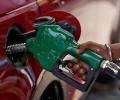
While consumers feel that petrol pinches directly, diesel hurts indirectly, as it is an input in almost all the goods and services we use.

'But extremely difficult, expensive and time consuming to rebuild it.'

Data shows that the current system of decentralised marketing and centralised procurement helps Punjab and Haryana farmers the most, while its efficacy in other states has been poor. Experts and farm leaders say success of the laws rests heavily on implementation.
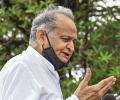
Rajasthan Chief Minister Ashok Gehlot-led Congress government on Wednesday presented the Budget for 2021-22 and said it will bring a Universal Healthcare scheme worth Rs 3,500 crore.
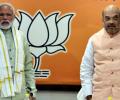
Corporate leaders said a stable government at the Centre will help boost infrastructure spend, address agricultural distress, and encouraging employment.
The government data released on May 17 showed a minor dip in headline inflation to 8.66 per cent in April, driven by a moderation in food and manufactured items prices.

India and five Central Asian countries on Thursday decided to establish a joint working group on Afghanistan at the senior officials' level, ministry of external affairs secretary (West) Reenat Sandhu said.

The incremental stress is mainly from sectors including power, infrastructure, constructions, hospitality, iron and steel, telecom, and realty.

Here's the full text of President Ram Nath Kovind's customary address to the joining sitting of Parliament on the first day of the budget session.

However, Icra Rating Principal Economist Aditi Nayar feels that the numbers are a bit too optimistic and need real heavy-lifting by the Centre and the states. "The survey forecasts on real and nominal GDP will require a substantial push from Central and state spending as private sector capacity expansion is anticipated to be intermittent, and sector-specific in the next couple of quarters," she said. Nayar added that private consumption is likely to chart a differentiated recovery across income and age groups. Based on the comments made in the Survey, she expects the Union Budget to incorporate a growth in gross tax revenue of 15-16 per cent.

The Indian economy can contract by 7.7 per cent in current financial year ending on March 31 and the growth could be 11 per cent in the next financial year, according to the Economic Survey tabled in Parliament by Finance Minister Nirmala Sitharaman. The contraction in FY21 is mainly due to coronavirus (Covid-19) pandemic and the visible damage caused by the subsequent countrywide lockdown to contain it. The survey unveiled two days before the Union Budget is broadly in line with forecasts by the Reserve Bank of India (RBI) which has said it expected the country's GDP to contract by 7.5 per cent in the year ending March 31.

Once it comes to power, the Bharatiya Janata Party's (BJP) focus areas would be infrastructure, agriculture, power and housing. Also on the cards is diversifying agriculture into energy and power sectors to help farmers generate more income, apart from reconsidering opening up the economy to multi-brand retail.

He said COVID-19 can be a catalyst towards the adoption of digital technologies in health and education and drive change in a way that even venture capital funds have not achieved despite pouring billions in investments.

'The corporate sector says by 2022 they will create 300 million jobs.' 'In the last 70 years we didn't do it, how will we do it in 5 years?' 'Only agriculture can bail out the economy. Unfortunately, it is not being looked into.'

Power and money are at the heart of the sordid story -- and it isn't over yet.

After Finance Minister Arun Jaitley presented his fifth straight budget in the Lok Sabha, Bharatiya Janata Party members and ministers from the Cabinet reacted positively to the Budget. Here are some of the reactions.

They said that massive public investment in infrastructure, social sectors and agriculture would generate employment and the Union Budget should give it a priority and allocate necessary funds for this.
India must be prepared for a big, fat fuel import bill in FY23 - barring any further avatars of the Covid virus - as refiners crank up runs, or crude processing rates, to meet the growing demand for fuels, and crude prices soar. Capacity additions by an Indian state-run refiner will reinforce the need for foreign crude. Demand for all fuels is expected to increase by 3-8 per cent next fiscal from 2021-22, reaching pre-pandemic levels, according to analysts and industry experts.

The government should set up agricultural co-operatives in every cluster of villages and in respective districts on a war-footing within a time limit. We should involve the services of our military personnel who retire at a young age with several years of working life still left in them and would be happy to contribute to nation-building, recommends Atul Gupta.

Agriculture and processed food exports dropped to a five-year low of $24 billion in 2015-16.

Nomura expects the fiscal deficit target of 3.5 per cent for 2016-17 to be met and to be consolidated further to 3 per cent of GDP in 2017-18.
Overall the Budget seems to be neutral and shows a similar trend as shown in the previous year Budget.

The restoration of the Chilahati-Haldibari railway link and signing of the pacts, providing for cooperation in areas of hydrocarbons, agriculture and textiles among others, came at a virtual summit between Prime Minister Narendra Modi and his Bangladeshi counterpart Sheikh Hasina.

Folk artist from Chhattisgarh Teejan Bai, Guelleh, Naik and theatre actor from Maharashtra Balwant Moreshwar Purandare will be honoured with Padma Vibushan.

India has received over USD 20 billion in FDI amid the coronavirus pandemic, Foreign Secretary Harsh Vardhan Shringla said on Tuesday, showcasing the country as one of the most attractive destinations for investment globally.

'We hope that the situation in Afghanistan does not pose a challenge to its neighbours and its territory is not used by terrorist groups'

She resigned soon after her husband and SAD president Sukhbir Singh Badal strongly opposed the bills in Lok Sabha on Thursday night, claiming these proposed legislations will "destroy" the agriculture sector in Punjab, and announced that Harsimrat Kaur Badal will quit the government in protest against these three bills.
Terminal Markets Projects will be expedited in all states that have potential for such projects, said a conference organized by the agriculture ministry.
